
Men’s Health Awareness Month: What Every Man Should Know About Hair Loss and Scalp Health

When we talk about hair loss and scalp health, the conversation is often framed around women. Marketing, products, and even educational content tend to reflect that. But the reality I see in my practice every day tells a very different story.
Men are experiencing hair loss and scalp conditions just as frequently, often earlier, and in many cases, they are dealing with it quietly, without the right information or support. Most of my male clients are under the age of 30. They come in unsure of what’s happening, frustrated by the changes they’re seeing, and often embarrassed by symptoms they don’t fully understand.
Men’s Health Awareness Month is an opportunity to shift that conversation because what these men are experiencing is common, but that doesn’t mean it should be ignored.
Hair Loss in Men Starts Earlier Than You Think
Hair loss in men is not uncommon. It is, in fact, one of the most common concerns affecting men’s health and self-image. When men enter puberty, lots of changes occur. One of them is a change in the hairline, which often starts at 18 or 19 years of age. It's a maturing of the hairline. Does this mean you're going to go bald? No, it's a natural progression into adulthood.
Research shows that androgenetic alopecia (male pattern baldness) accounts for more than 95% of hair loss in men. By the age of 35, approximately two-thirds of men will experience some degree of noticeable hair thinning. By age 50, that number rises to around 85%. What’s often overlooked is how early it can begin. Around 25% of men start to see signs of hair loss before the age of 21.
So if you’ve noticed your hairline thinning, your crown thinning, or your hair feeling less dense than it once did, you are not alone, and you are not imagining it.
What Is Actually Happening to the Hair?
The most common driver of male hair loss is sensitivity to a hormone called dihydrotestosterone (DHT). Over time, DHT binds to receptors in the hair follicle and causes a process known as miniaturization. The follicle gradually shrinks, producing thinner, weaker hairs with shorter growth cycles. Eventually, the follicle may stop producing hair altogether.
This is why hair loss often feels progressive. It’s not sudden; it’s a slow, biological shift happening at the follicular level. In men, this process tends to follow a recognizable pattern: recession at the temples and thinning at the crown.
Why Understanding Your Stage of Hair Loss Matters
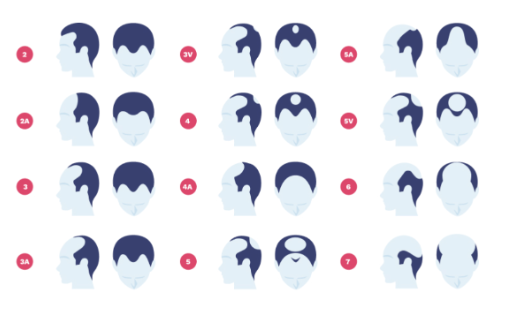
Hair loss doesn’t happen randomly; it progresses over time. The Norwood Scale is the clinical tool used to classify male pattern baldness into seven stages, ranging from minimal change to advanced hair loss. While many men are unfamiliar with it, it plays an important role in determining how to approach treatment.
In earlier stages, there is still a significant opportunity to stabilize and improve hair density. In later stages, options become more limited and often more invasive. This is one of the most important things I emphasize to my clients: Timing matters. The earlier you understand what stage you’re in, the more effectively we can intervene.
The Missing Piece for Men is Scalp Health
One of the biggest misconceptions I see is the idea that hair loss is only about hair. It’s not. It’s about the scalp environment. In my practice, approximately 60% of my male clients present with seborrheic dermatitis, a chronic inflammatory condition of the scalp that causes flaking, redness, itching, and irritation. And almost every one of them feels self-conscious about it. They’ve tried different shampoos. They’ve attempted to manage it on their own. They’ve often assumed it’s just “dandruff.” But perhaps, it’s not.
What many men need are anti-inflammatory shampoos, like Juniper therapy shampoo, to reduce the populations of Malassezia yeast on the scalp, decreasing micro-inflammation that can exacerbate structural hair thinning.
Plus, nutritional and metabolic optimization is key at an early age. Micronutrient synthesis support ensures adequate serum levels of ferritin (iron stores), zinc, and vitamin D, which optimizes the high metabolic demands of rapidly dividing matrix cells within the hair bulb. Then there’s oxidative stress reduction, which is chronic physiological stress that triggers premature telogen effluvium (widespread shedding) by elevating systemic cortisol. Managing stress protects the follicular microenvironment from premature regression.
What I Do in My Practice as a Certified Trichologist
When a client comes to see me, the goal is not just to look at the hair. It’s to understand the full picture. Every consultation begins with a comprehensive scalp analysis. Using advanced diagnostic tools like a dermatoscope, I closely examine the scalp and follicles to assess:
Follicular density and health
Signs of inflammation
Scaling, buildup, or barrier disruption
Early indicators of conditions such as androgenetic alopecia or scarring alopecia
But diagnosis is not just visual. We also have an in-depth conversation about your lifestyle, because hair health is influenced by multiple factors. We look at:
Stress levels and nervous system health
Diet and nutritional intake
Hair care and styling routines
Product use and chemical exposure
Medical history and, when available, bloodwork
All of this takes place in a private, one-on-one setting. My goal is to create a space where you feel comfortable asking questions and getting real answers without judgment.
Once we understand what’s happening, we build a treatment plan that is specific to you. There is no one-size-fits-all solution.
For many male clients, this may include:
Topical plant-based peptide solutions designed to support thicker, healthier hair growth
Topical Minoxidil, when appropriate, to stimulate follicles. This acts as a vasodilator, opening ATP-sensitive potassium channels to increase blood flow to the dermal papilla. This prolongs the anagen (growth) phase and converts telogen (resting) follicles back into active growth.
Targeted scalp treatments to reduce inflammation and restore balance
For those dealing with seborrheic dermatitis or chronic scalp irritation, I often incorporate treatments such as:
Juniper scalp cream, which is highly effective in calming inflammation
Antioxidant and exfoliating scalp therapies to rebalance the scalp environment
If a medical condition is involved, I collaborate with trusted specialists to ensure you are receiving the appropriate level of care.
What Trichology Offers That Others Don’t
Trichology sits at the intersection of science, hair care, and clinical insight. It is not just about recommending products or addressing surface-level concerns. It is about identifying root causes and developing a strategy to support long-term scalp and hair health.
We are looking at:
The biology of the follicle
The condition of the scalp
The progression of hair loss
The most effective point of intervention
This is what allows for real, measurable results.
Hair loss and scalp conditions are incredibly common in men, but they are also highly misunderstood. You do not have to accept thinning, irritation, or discomfort without understanding why it’s happening. And you do not have to navigate it alone. The earlier you seek answers, the more options you have, and the better your outcomes will be.
If you’ve been noticing changes in your hair or scalp, take that seriously. Not with panic, but with intention, because taking care of your hair is not about vanity. It’s about health, awareness, and confidence. And you deserve all three.
Copyright 2026 © Penny James Trichology Center
